
Kategorie wiadomości
2026-11-26
AC-Coupled vs DC-Coupled Balcony Energy Storage: Which Is Better?
Introduction
Balcony energy storage is becoming an increasingly important part of the residential energy market, particularly in regions where homeowners want to maximize solar self-consumption,
reduce electricity bills, and make better use of limited installation space.
As the market develops, buyers and installers are facing an important technical question: Should they choose an AC-coupled or DC-coupled balcony energy storage system?
Both architectures can store solar energy and supply electricity to household loads. However, they differ in how solar panels, batteries, inverters, and household electrical systems are connected.
The choice affects more than just energy conversion efficiency. It also influences installation complexity, compatibility with existing solar equipment, system expansion, monitoring, and overall project costs.
For distributors, installers, and energy storage brands, understanding these differences is essential when selecting products for different residential markets.
In this guide, BST Power explains how AC-coupled and DC-coupled balcony energy storage systems work, their advantages and limitations, and the key factors to consider when choosing the right solution.
1. What Is AC-Coupled Balcony Energy Storage?
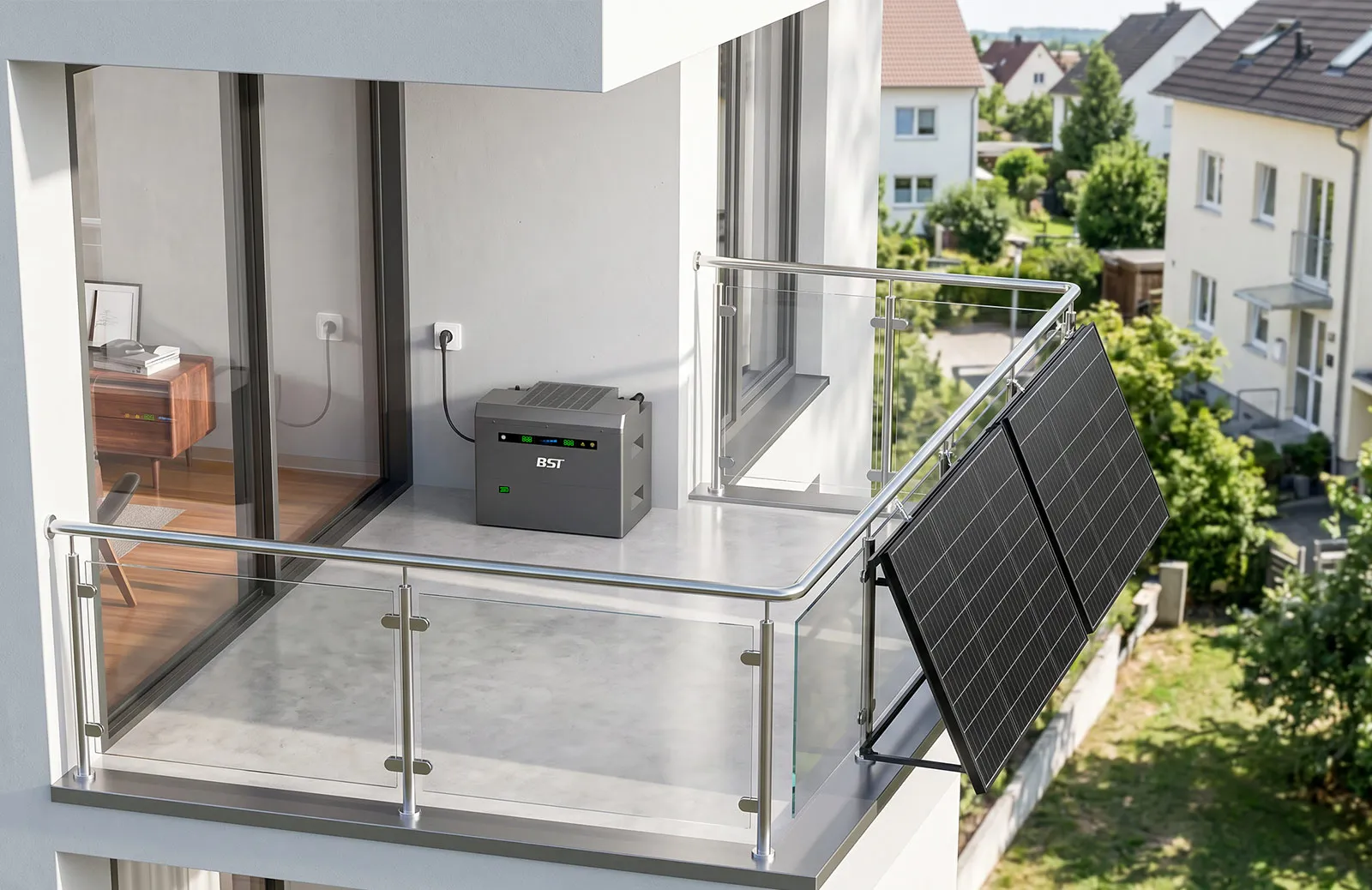
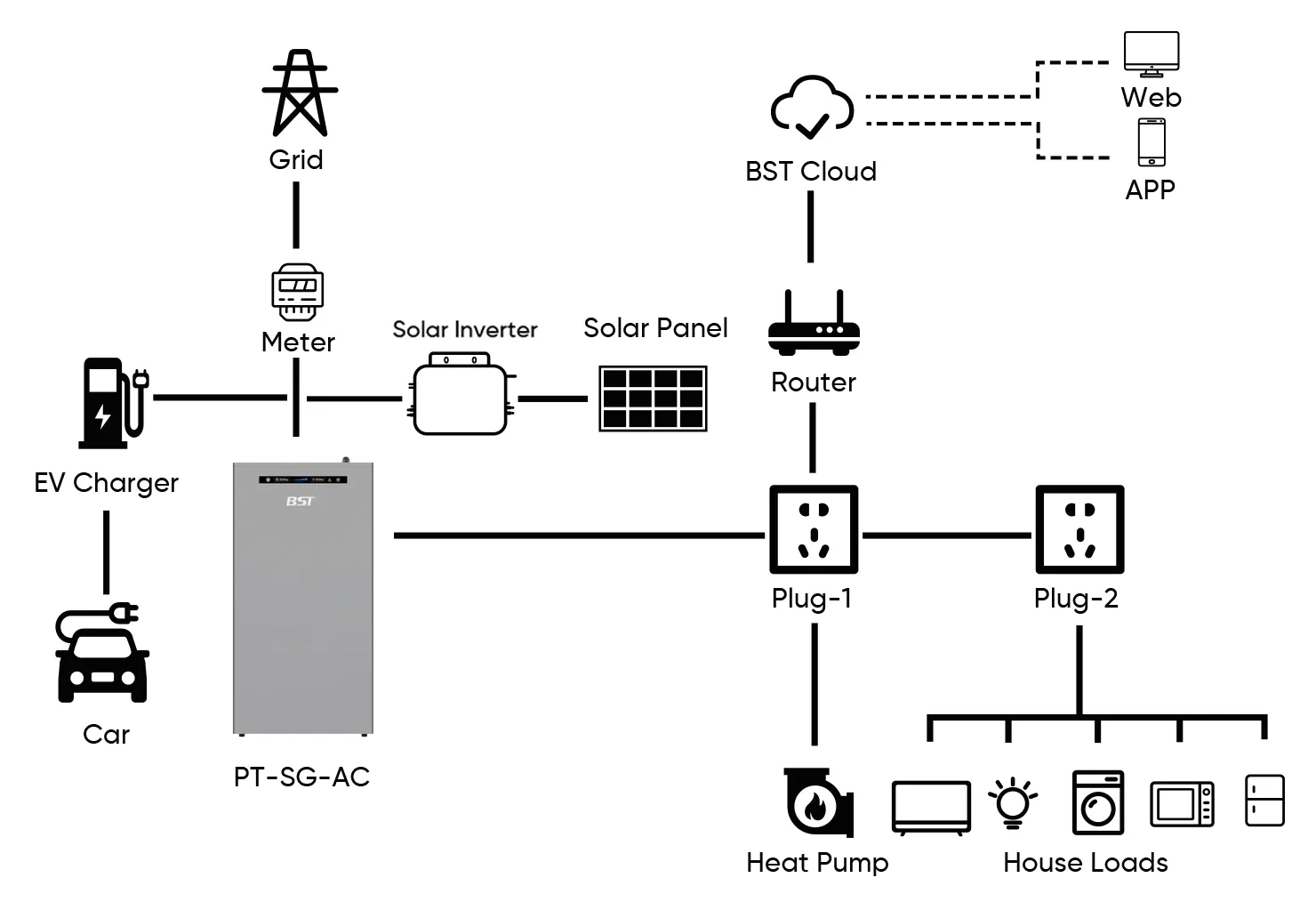
An AC-coupled balcony energy storage system connects the battery storage unit to the AC side of the electrical system.
In a typical configuration, solar panels generate DC electricity, which is converted into AC electricity through a microinverter or PV inverter.
The AC power can then supply household loads, while excess electricity can be used to charge an AC-coupled battery through its bidirectional inverter or charging system.
A simplified energy flow is:
Solar Panels → Microinverter → AC System → AC-Coupled Battery → Household Loads
The exact energy path depends on the system design and control strategy.
How Does It Work?
When solar panels generate electricity during the day, the system prioritizes household consumption according to its energy management settings.
When solar generation exceeds household demand, surplus energy can be stored in the battery, provided the system supports the required charging and control functions.
When solar generation decreases or electricity demand increases, the battery discharges to help supply household loads.
Depending on the product design, AC-coupled storage may also support grid charging and scheduled energy management.
Key Advantages of AC-Coupled Balcony Storage
1. Flexible Integration with Existing Solar Systems
One of the biggest advantages of AC coupling is its potential for retrofitting.
Homeowners who already have a balcony solar system with microinverters may be able to add a compatible AC-coupled battery without replacing their existing PV equipment.
This can reduce installation disruption and make energy storage upgrades more practical.
2. Independent PV and Battery Equipment
In many AC-coupled configurations, the PV inverter and battery inverter operate as separate units.
This allows the solar generation equipment and battery storage capacity to be selected or upgraded independently, subject to system compatibility and electrical limitations.
3. Flexible Residential Applications
AC-coupled solutions can be suitable for apartments, balconies, small houses, and residential projects where preserving existing solar equipment is important.
4. Potentially Simpler Retrofit Projects
For installers, retaining an existing PV inverter can reduce the need for major changes to the original solar installation.
However, compatibility, protection, metering, and local grid requirements must still be checked before installation.
2. What Is DC-Coupled Balcony Energy Storage?
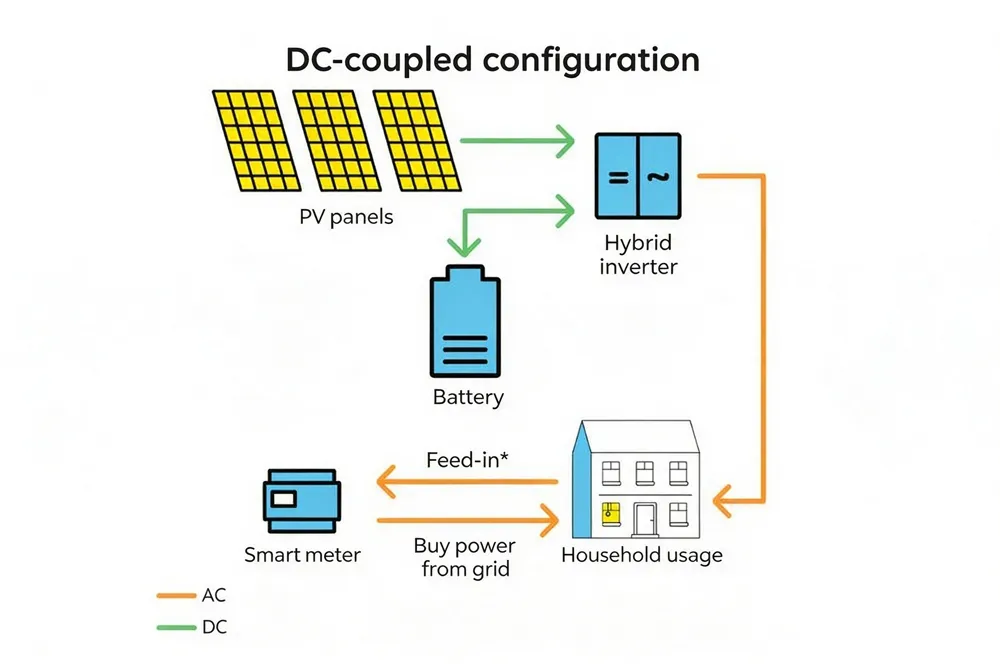
A DC-coupled balcony energy storage system connects solar panels and battery storage on the DC side of the system.
Instead of converting solar electricity into AC before charging the battery, solar-generated DC electricity can be directed to the battery through an appropriate charge controller or DC/DC conversion stage.
A simplified energy flow is:
Solar Panels → MPPT / DC Charging System → Battery → Inverter → Household Loads
The PV and battery systems are coordinated through a shared DC-side architecture, commonly using a compatible hybrid inverter or integrated energy storage unit.
How Does It Work?
Solar panels generate DC electricity, which is managed by the MPPT charging system.
When household electricity demand is low, excess solar generation can charge the battery directly through the DC charging path.
When household demand increases or solar generation decreases, the stored DC energy is converted into AC electricity by the inverter to supply household loads.
Key Advantages of DC-Coupled Balcony Storage
1. Fewer Conversion Stages in the Solar-to-Battery Path
A major advantage of DC coupling is that solar energy can be stored without first being converted into AC and then converted back into DC.
This can reduce conversion losses when solar electricity is primarily stored for later use.
Actual system efficiency depends on inverter performance, MPPT operation, battery characteristics, operating conditions, and the complete energy conversion path.
2. Integrated System Architecture
DC-coupled systems can integrate solar charging, battery management, and power conversion within a coordinated architecture.
This can simplify equipment selection in new solar-plus-storage installations.
3. Suitable for New Integrated Installations
When designing a new balcony solar and storage system from the beginning, DC coupling may provide a more integrated solution because the PV input, battery, and inverter can be designed together.
4. Coordinated Energy Management
A properly designed DC-coupled system can coordinate solar generation, battery charging, and household power delivery through its energy management controls.
This is particularly useful for applications where solar energy is mainly stored for evening consumption.
3. AC-Coupled vs DC-Coupled Balcony Energy Storage: Key Differences
Although both architectures provide residential energy storage, they serve different installation requirements.
Here is a comparison of their main characteristics:
| Comparison Factor | AC-Coupled | DC-Coupled |
|---|---|---|
| Connection point | AC side | DC side |
| Solar-to-battery path | Usually involves DC-AC-DC conversion | Can charge battery through a DC-side path |
| Existing microinverter compatibility | Often suitable with compatible equipment | May require system redesign or different PV-side equipment |
| Retrofit flexibility | Generally more flexible | Depends on existing inverter architecture |
| New system integration | Flexible modular design | Often suitable for integrated designs |
| Conversion efficiency | Additional conversion stages may introduce losses | Can reduce conversion stages |
| Equipment configuration | Often uses separate PV and battery conversion equipment | Often uses a shared hybrid inverter or integrated conversion architecture |
| System expansion | Depends on inverter and communication limits | Depends on hybrid inverter and battery compatibility |
| Typical application | Existing balcony solar upgrades | New integrated solar-plus-storage installations |
Important: Neither architecture is automatically more efficient, less expensive, or better for every application. The actual result depends on the equipment configuration, power flow, and operating conditions.
4. Which System Is More Efficient?
Energy conversion efficiency is one of the most frequently discussed factors when comparing AC-coupled and DC-coupled battery storage.
However, it is important to understand that efficiency depends on how electricity moves through the entire system.
AC-Coupled Energy Conversion
In a typical AC-coupled configuration, solar electricity follows this path when charging the battery:
Solar DC → PV inverter → AC electricity → Battery inverter/charger → Battery DC
When the battery discharges:
Battery DC → Battery inverter → AC electricity → Household loads
Because solar electricity may pass through additional conversion stages before being stored, AC coupling can introduce more conversion losses during solar-to-battery charging.
However, when solar electricity is used directly by household appliances, it may only need to pass through the PV inverter before reaching the AC loads.
DC-Coupled Energy Conversion
In a typical DC-coupled configuration, solar electricity can follow this path:
Solar DC → MPPT / DC charging system → Battery DC
When the battery supplies household loads:
Battery DC → Hybrid inverter → AC electricity → Household loads
By avoiding an intermediate DC-to-AC-to-DC conversion during solar charging, DC coupling can offer an efficiency advantage when a large proportion of solar energy is stored for later use.
Which Is More Energy-Efficient?
The answer depends on the energy consumption pattern.
-
If solar electricity is mainly consumed immediately during the day, the efficiency difference may be smaller.
-
If a significant proportion of solar generation is stored in the battery, DC coupling may reduce conversion losses.
-
If an existing PV system is already installed, the cost and disruption of changing its inverter architecture must also be considered.
For an accurate comparison, buyers should request complete system efficiency data rather than comparing battery cell efficiency or inverter efficiency separately.
5. Installation: Which Architecture Is Easier for Balcony Solar Projects?
Installation conditions are especially important for balcony energy storage because many residential users have limited space and cannot easily modify their existing electrical systems.
AC-Coupled: A Practical Retrofit Option
For apartments and existing balcony PV installations, AC-coupled systems can provide a convenient way to introduce battery storage.
For example, a homeowner already using solar panels with microinverters may want to add storage without replacing the original solar equipment.
If the existing PV system and the new battery system are compatible, an AC-coupled solution may reduce installation changes.
This makes it an attractive option for installers serving residential retrofit markets.
DC-Coupled: Better Planned as an Integrated System
DC-coupled systems are often more straightforward to design when solar panels, batteries, and inverters are selected together from the beginning.
However, installers must carefully consider:
-
PV input voltage and current.
-
MPPT operating voltage range.
-
Maximum PV input power.
-
Battery voltage and capacity.
-
BMS communication compatibility.
-
Inverter power rating.
-
Grid connection and protection requirements.
For both architectures, installation must follow the manufacturer's instructions and applicable local electrical and grid regulations.
6. How to Choose the Right Balcony Energy Storage System?
For distributors, installers, and energy storage brands, the best system is not necessarily the one with the most advanced specifications.
It is the one that matches the target market and actual installation requirements.
Here are five important factors to evaluate.
1. Existing Solar System Configuration
Start by understanding the customer's current solar installation.
If the customer already has a working microinverter-based balcony PV system, an AC-coupled battery may be a practical retrofit option.
If the customer is purchasing a complete solar-plus-storage solution, a DC-coupled system may be worth considering.
2. Household Electricity Consumption
The battery capacity should match the household's electricity consumption pattern.
For example:
-
Daytime consumption determines how much solar electricity is used directly.
-
Evening consumption determines how much stored energy may be required.
-
Peak loads influence the inverter's required output power.
-
Seasonal solar generation affects charging opportunities.
A properly sized system should consider both usable battery capacity and inverter output power.
3. Available Installation Space
Balcony energy storage products are often designed for compact residential environments.
Buyers should consider:
-
Battery dimensions and weight.
-
Wall-mounted or floor-standing installation.
-
Indoor or outdoor installation requirements.
-
Ventilation and operating temperature.
-
Cable routing and maintenance access.
A compact design can improve installation flexibility, but thermal management and electrical safety must never be compromised.
4. Smart Energy Management
Modern balcony energy storage is not just about storing electricity.
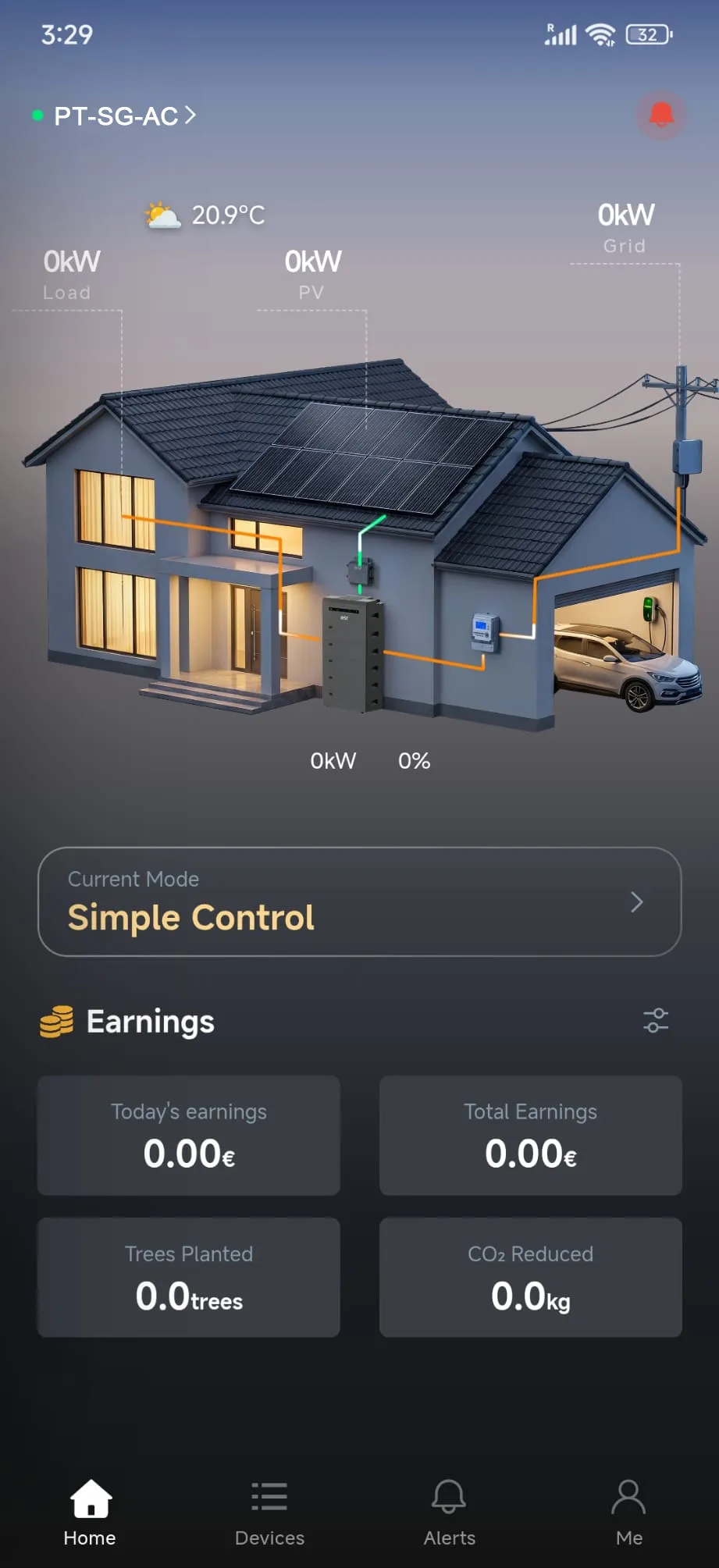
Users increasingly expect intelligent control and convenient monitoring.
Important features include:
-
Real-time solar generation monitoring.
-
Household consumption monitoring.
-
Battery charging and discharging control.
-
Scheduled energy management.
-
Grid import and export monitoring.
-
Remote APP monitoring.
-
Support for compatible smart meters and energy management devices.
For brands and distributors, software customization and compatibility can be important product differentiation factors.
5. Scalability and Future Expansion
Some residential customers may start with a smaller battery capacity and expand their systems as their energy needs increase.
Before purchasing, installers should check:
-
Maximum supported battery capacity.
-
Number of parallel units.
-
Communication protocols.
-
Inverter power limitations.
-
Charging and discharging current.
-
Firmware and system configuration requirements.
A scalable architecture can help distributors serve customers with different budgets and energy requirements.
7. Why AC-Coupled Balcony Storage Is Important for European Residential Markets
European balcony solar markets have specific characteristics that make system flexibility particularly important.
Many users live in apartments or smaller residential properties, where roof-mounted solar installations may not be practical.
Balcony PV systems provide an alternative way to generate renewable electricity, while battery storage can help users increase self-consumption.
For these applications, several product characteristics matter:
Compact and Space-Efficient Design
Products should fit typical residential installation environments without occupying excessive living space.
Flexible System Integration
Compatibility with existing microinverters and other PV equipment can make retrofit projects easier.
Simple Monitoring and Control
Users need clear information about solar generation, battery status, household consumption, and energy flows.
Expandable Battery Capacity
Modular expansion can help users increase storage capacity as their electricity consumption changes.
Compliance with Local Requirements
Manufacturers and distributors should verify applicable national grid connection rules, electrical safety requirements, product certification, and installation restrictions before introducing products into a market.
For example, Germany, France, Italy, and the Netherlands may have different requirements for residential solar and storage equipment. Product suitability should always be assessed for the specific market and system configuration.
8. How BST Power Supports Balcony Energy Storage OEM/ODM Projects
Choosing the right AC-coupled or DC-coupled architecture is only one part of developing a successful balcony energy storage product.
For energy storage brands and distributors, product differentiation also depends on battery configuration, inverter integration, software functionality, industrial design, and manufacturing flexibility.
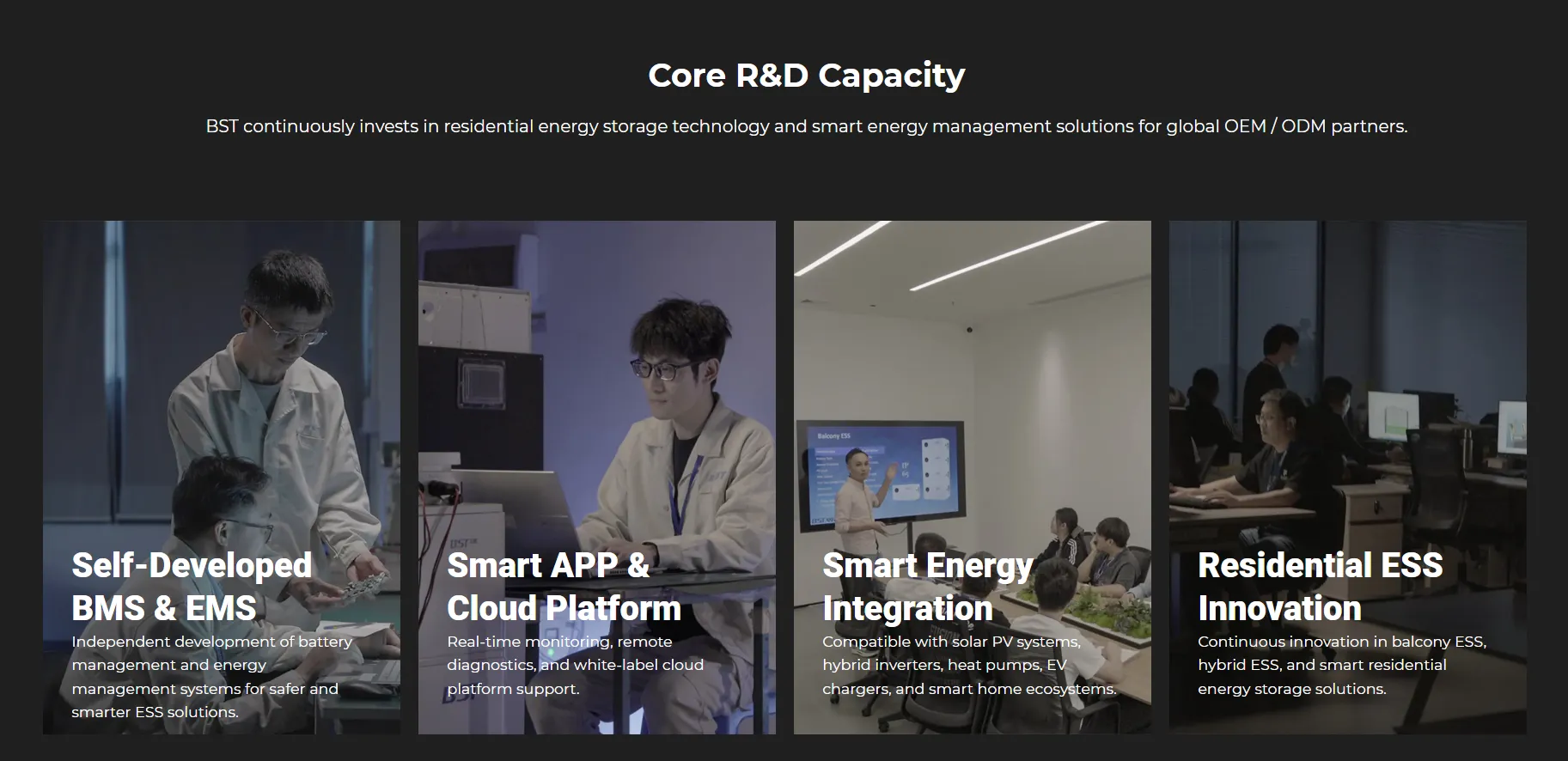
BST Power focuses on residential energy storage solutions and supports OEM/ODM cooperation for different market requirements.
Our customization capabilities cover several areas:
Hardware and Battery Configuration
Battery capacity, product structure, enclosure design, and system configuration can be developed according to project requirements and technical feasibility.
BMS and EMS Customization
Battery management and energy management functions can be adapted to support different system configurations and application requirements.
Inverter and Communication Integration
System integration requires compatibility across battery voltage, charging parameters, communication protocols, and inverter control logic.
BST Power can work with customers on integration requirements and configuration development.
APP and Cloud Platform Customization
For brands building their own residential energy storage product portfolios, software is an important part of the customer experience.
Depending on project requirements, APP interfaces, monitoring functions, and cloud platform branding can be customized.
Industrial Design and Branding
Enclosure design, product appearance, logos, packaging, and other branding elements can be considered as part of an OEM/ODM project.
Our goal is to help partners develop residential energy storage products that match their target markets, technical requirements, and brand positioning.
9. Frequently Asked Questions
Is AC-coupled better than DC-coupled balcony energy storage?
Not necessarily. AC-coupled storage is often a practical choice for adding batteries to existing balcony solar systems with microinverters.
DC-coupled storage can be attractive for new integrated solar-plus-storage installations. The right choice depends on equipment compatibility,
energy consumption, installation conditions, and project costs.
Can I add an AC-coupled battery to an existing balcony solar system?
In many cases, yes. However, the battery system must support the existing electrical configuration and meet the required grid, protection,
and control requirements. Compatibility should be confirmed before installation.
Is DC-coupled battery storage more efficient?
DC-coupled systems can reduce conversion stages when solar electricity is stored directly in the battery.
This may improve solar-to-battery conversion efficiency. However, actual performance depends on the complete system design and operating conditions.
Can AC-coupled and DC-coupled systems support battery expansion?
Both architectures can support expansion, depending on their inverter design, battery management system, communication protocols, and manufacturer specifications.
Buyers should confirm the maximum supported capacity and number of parallel units.
What battery chemistry is commonly used in balcony energy storage?
Lithium iron phosphate (LiFePO4) is widely used in residential energy storage because of its thermal stability, cycle life, and suitability for stationary battery applications.
Actual battery performance depends on cell quality, BMS design, operating temperature, and system configuration.
What should distributors consider when sourcing balcony energy storage products?
Distributors should evaluate product safety, local certification, inverter compatibility, battery capacity, scalability, APP functionality, after-sales support, and manufacturer capabilities.
For private-label brands, OEM/ODM flexibility and long-term product consistency are also important considerations.
Conclusion: Choose the Architecture That Fits Your Market
AC-coupled and DC-coupled balcony energy storage systems both have important roles in the residential solar market.
AC coupling is often a practical option for retrofitting existing balcony PV systems, especially when customers want to retain their current microinverters.
DC coupling can be an attractive choice for new integrated solar-plus-storage systems, particularly when reducing conversion stages and coordinating PV and battery operation are priorities.
For installers, distributors, and energy storage brands, the most important step is to evaluate the complete system rather than choosing an architecture based on a single specification.
At BST Power, we believe that successful residential energy storage solutions should combine reliable battery technology, compatible power electronics, intelligent energy management, and flexible product design.
Looking for a balcony energy storage OEM/ODM partner?
Contact BST Power to discuss your target market, system architecture, battery configuration, and product customization requirements.
Website: https://www.bstess.com/
Explore our residential energy storage solutions and OEM/ODM capabilities to develop your next energy storage product.
Introduction
Balcony energy storage is becoming an increasingly important part of the residential energy market, particularly in regions where homeowners want to maximize solar self-consumption,
reduce electricity bills, and make better use of limited installation space.
As the market develops, buyers and installers are facing an important technical question: Should they choose an AC-coupled or DC-coupled balcony energy storage system?
Both architectures can store solar energy and supply electricity to household loads. However, they differ in how solar panels, batteries, inverters, and household electrical systems are connected.
The choice affects more than just energy conversion efficiency. It also influences installation complexity, compatibility with existing solar equipment, system expansion, monitoring, and overall project costs.
For distributors, installers, and energy storage brands, understanding these differences is essential when selecting products for different residential markets.
In this guide, BST Power explains how AC-coupled and DC-coupled balcony energy storage systems work, their advantages and limitations, and the key factors to consider when choosing the right solution.
1. What Is AC-Coupled Balcony Energy Storage?
An AC-coupled balcony energy storage system connects the battery storage unit to the AC side of the electrical system.
In a typical configuration, solar panels generate DC electricity, which is converted into AC electricity through a microinverter or PV inverter.
The AC power can then supply household loads, while excess electricity can be used to charge an AC-coupled battery through its bidirectional inverter or charging system.
A simplified energy flow is:
Solar Panels → Microinverter → AC System → AC-Coupled Battery → Household Loads
The exact energy path depends on the system design and control strategy.
How Does It Work?
When solar panels generate electricity during the day, the system prioritizes household consumption according to its energy management settings.
When solar generation exceeds household demand, surplus energy can be stored in the battery, provided the system supports the required charging and control functions.
When solar generation decreases or electricity demand increases, the battery discharges to help supply household loads.
Depending on the product design, AC-coupled storage may also support grid charging and scheduled energy management.
Key Advantages of AC-Coupled Balcony Storage
1. Flexible Integration with Existing Solar Systems
One of the biggest advantages of AC coupling is its potential for retrofitting.
Homeowners who already have a balcony solar system with microinverters may be able to add a compatible AC-coupled battery without replacing their existing PV equipment.
This can reduce installation disruption and make energy storage upgrades more practical.
2. Independent PV and Battery Equipment
In many AC-coupled configurations, the PV inverter and battery inverter operate as separate units.
This allows the solar generation equipment and battery storage capacity to be selected or upgraded independently, subject to system compatibility and electrical limitations.
3. Flexible Residential Applications
AC-coupled solutions can be suitable for apartments, balconies, small houses, and residential projects where preserving existing solar equipment is important.
4. Potentially Simpler Retrofit Projects
For installers, retaining an existing PV inverter can reduce the need for major changes to the original solar installation.
However, compatibility, protection, metering, and local grid requirements must still be checked before installation.
2. What Is DC-Coupled Balcony Energy Storage?
A DC-coupled balcony energy storage system connects solar panels and battery storage on the DC side of the system.
Instead of converting solar electricity into AC before charging the battery, solar-generated DC electricity can be directed to the battery through an appropriate charge controller or DC/DC conversion stage.
A simplified energy flow is:
Solar Panels → MPPT / DC Charging System → Battery → Inverter → Household Loads
The PV and battery systems are coordinated through a shared DC-side architecture, commonly using a compatible hybrid inverter or integrated energy storage unit.
How Does It Work?
Solar panels generate DC electricity, which is managed by the MPPT charging system.
When household electricity demand is low, excess solar generation can charge the battery directly through the DC charging path.
When household demand increases or solar generation decreases, the stored DC energy is converted into AC electricity by the inverter to supply household loads.
Key Advantages of DC-Coupled Balcony Storage
1. Fewer Conversion Stages in the Solar-to-Battery Path
A major advantage of DC coupling is that solar energy can be stored without first being converted into AC and then converted back into DC.
This can reduce conversion losses when solar electricity is primarily stored for later use.
Actual system efficiency depends on inverter performance, MPPT operation, battery characteristics, operating conditions, and the complete energy conversion path.
2. Integrated System Architecture
DC-coupled systems can integrate solar charging, battery management, and power conversion within a coordinated architecture.
This can simplify equipment selection in new solar-plus-storage installations.
3. Suitable for New Integrated Installations
When designing a new balcony solar and storage system from the beginning, DC coupling may provide a more integrated solution because the PV input, battery, and inverter can be designed together.
4. Coordinated Energy Management
A properly designed DC-coupled system can coordinate solar generation, battery charging, and household power delivery through its energy management controls.
This is particularly useful for applications where solar energy is mainly stored for evening consumption.
3. AC-Coupled vs DC-Coupled Balcony Energy Storage: Key Differences
Although both architectures provide residential energy storage, they serve different installation requirements.
Here is a comparison of their main characteristics:
| Comparison Factor | AC-Coupled | DC-Coupled |
|---|---|---|
| Connection point | AC side | DC side |
| Solar-to-battery path | Usually involves DC-AC-DC conversion | Can charge battery through a DC-side path |
| Existing microinverter compatibility | Often suitable with compatible equipment | May require system redesign or different PV-side equipment |
| Retrofit flexibility | Generally more flexible | Depends on existing inverter architecture |
| New system integration | Flexible modular design | Often suitable for integrated designs |
| Conversion efficiency | Additional conversion stages may introduce losses | Can reduce conversion stages |
| Equipment configuration | Often uses separate PV and battery conversion equipment | Often uses a shared hybrid inverter or integrated conversion architecture |
| System expansion | Depends on inverter and communication limits | Depends on hybrid inverter and battery compatibility |
| Typical application | Existing balcony solar upgrades | New integrated solar-plus-storage installations |
Important: Neither architecture is automatically more efficient, less expensive, or better for every application. The actual result depends on the equipment configuration, power flow, and operating conditions.
4. Which System Is More Efficient?
Energy conversion efficiency is one of the most frequently discussed factors when comparing AC-coupled and DC-coupled battery storage.
However, it is important to understand that efficiency depends on how electricity moves through the entire system.
AC-Coupled Energy Conversion
In a typical AC-coupled configuration, solar electricity follows this path when charging the battery:
Solar DC → PV inverter → AC electricity → Battery inverter/charger → Battery DC
When the battery discharges:
Battery DC → Battery inverter → AC electricity → Household loads
Because solar electricity may pass through additional conversion stages before being stored, AC coupling can introduce more conversion losses during solar-to-battery charging.
However, when solar electricity is used directly by household appliances, it may only need to pass through the PV inverter before reaching the AC loads.
DC-Coupled Energy Conversion
In a typical DC-coupled configuration, solar electricity can follow this path:
Solar DC → MPPT / DC charging system → Battery DC
When the battery supplies household loads:
Battery DC → Hybrid inverter → AC electricity → Household loads
By avoiding an intermediate DC-to-AC-to-DC conversion during solar charging, DC coupling can offer an efficiency advantage when a large proportion of solar energy is stored for later use.
Which Is More Energy-Efficient?
The answer depends on the energy consumption pattern.
-
If solar electricity is mainly consumed immediately during the day, the efficiency difference may be smaller.
-
If a significant proportion of solar generation is stored in the battery, DC coupling may reduce conversion losses.
-
If an existing PV system is already installed, the cost and disruption of changing its inverter architecture must also be considered.
For an accurate comparison, buyers should request complete system efficiency data rather than comparing battery cell efficiency or inverter efficiency separately.
5. Installation: Which Architecture Is Easier for Balcony Solar Projects?
Installation conditions are especially important for balcony energy storage because many residential users have limited space and cannot easily modify their existing electrical systems.
AC-Coupled: A Practical Retrofit Option
For apartments and existing balcony PV installations, AC-coupled systems can provide a convenient way to introduce battery storage.
For example, a homeowner already using solar panels with microinverters may want to add storage without replacing the original solar equipment.
If the existing PV system and the new battery system are compatible, an AC-coupled solution may reduce installation changes.
This makes it an attractive option for installers serving residential retrofit markets.
DC-Coupled: Better Planned as an Integrated System
DC-coupled systems are often more straightforward to design when solar panels, batteries, and inverters are selected together from the beginning.
However, installers must carefully consider:
-
PV input voltage and current.
-
MPPT operating voltage range.
-
Maximum PV input power.
-
Battery voltage and capacity.
-
BMS communication compatibility.
-
Inverter power rating.
-
Grid connection and protection requirements.
For both architectures, installation must follow the manufacturer's instructions and applicable local electrical and grid regulations.
6. How to Choose the Right Balcony Energy Storage System?
For distributors, installers, and energy storage brands, the best system is not necessarily the one with the most advanced specifications.
It is the one that matches the target market and actual installation requirements.
Here are five important factors to evaluate.
1. Existing Solar System Configuration
Start by understanding the customer's current solar installation.
If the customer already has a working microinverter-based balcony PV system, an AC-coupled battery may be a practical retrofit option.
If the customer is purchasing a complete solar-plus-storage solution, a DC-coupled system may be worth considering.
2. Household Electricity Consumption
The battery capacity should match the household's electricity consumption pattern.
For example:
-
Daytime consumption determines how much solar electricity is used directly.
-
Evening consumption determines how much stored energy may be required.
-
Peak loads influence the inverter's required output power.
-
Seasonal solar generation affects charging opportunities.
A properly sized system should consider both usable battery capacity and inverter output power.
3. Available Installation Space
Balcony energy storage products are often designed for compact residential environments.
Buyers should consider:
-
Battery dimensions and weight.
-
Wall-mounted or floor-standing installation.
-
Indoor or outdoor installation requirements.
-
Ventilation and operating temperature.
-
Cable routing and maintenance access.
A compact design can improve installation flexibility, but thermal management and electrical safety must never be compromised.
4. Smart Energy Management
Modern balcony energy storage is not just about storing electricity.
Users increasingly expect intelligent control and convenient monitoring.
Important features include:
-
Real-time solar generation monitoring.
-
Household consumption monitoring.
-
Battery charging and discharging control.
-
Scheduled energy management.
-
Grid import and export monitoring.
-
Remote APP monitoring.
-
Support for compatible smart meters and energy management devices.
For brands and distributors, software customization and compatibility can be important product differentiation factors.
5. Scalability and Future Expansion
Some residential customers may start with a smaller battery capacity and expand their systems as their energy needs increase.
Before purchasing, installers should check:
-
Maximum supported battery capacity.
-
Number of parallel units.
-
Communication protocols.
-
Inverter power limitations.
-
Charging and discharging current.
-
Firmware and system configuration requirements.
A scalable architecture can help distributors serve customers with different budgets and energy requirements.
7. Why AC-Coupled Balcony Storage Is Important for European Residential Markets
European balcony solar markets have specific characteristics that make system flexibility particularly important.
Many users live in apartments or smaller residential properties, where roof-mounted solar installations may not be practical.
Balcony PV systems provide an alternative way to generate renewable electricity, while battery storage can help users increase self-consumption.
For these applications, several product characteristics matter:
Compact and Space-Efficient Design
Products should fit typical residential installation environments without occupying excessive living space.
Flexible System Integration
Compatibility with existing microinverters and other PV equipment can make retrofit projects easier.
Simple Monitoring and Control
Users need clear information about solar generation, battery status, household consumption, and energy flows.
Expandable Battery Capacity
Modular expansion can help users increase storage capacity as their electricity consumption changes.
Compliance with Local Requirements
Manufacturers and distributors should verify applicable national grid connection rules, electrical safety requirements, product certification, and installation restrictions before introducing products into a market.
For example, Germany, France, Italy, and the Netherlands may have different requirements for residential solar and storage equipment. Product suitability should always be assessed for the specific market and system configuration.
8. How BST Power Supports Balcony Energy Storage OEM/ODM Projects
Choosing the right AC-coupled or DC-coupled architecture is only one part of developing a successful balcony energy storage product.
For energy storage brands and distributors, product differentiation also depends on battery configuration, inverter integration, software functionality, industrial design, and manufacturing flexibility.
BST Power focuses on residential energy storage solutions and supports OEM/ODM cooperation for different market requirements.
Our customization capabilities cover several areas:
Hardware and Battery Configuration
Battery capacity, product structure, enclosure design, and system configuration can be developed according to project requirements and technical feasibility.
BMS and EMS Customization
Battery management and energy management functions can be adapted to support different system configurations and application requirements.
Inverter and Communication Integration
System integration requires compatibility across battery voltage, charging parameters, communication protocols, and inverter control logic.
BST Power can work with customers on integration requirements and configuration development.
APP and Cloud Platform Customization
For brands building their own residential energy storage product portfolios, software is an important part of the customer experience.
Depending on project requirements, APP interfaces, monitoring functions, and cloud platform branding can be customized.
Industrial Design and Branding
Enclosure design, product appearance, logos, packaging, and other branding elements can be considered as part of an OEM/ODM project.
Our goal is to help partners develop residential energy storage products that match their target markets, technical requirements, and brand positioning.
9. Frequently Asked Questions
Is AC-coupled better than DC-coupled balcony energy storage?
Not necessarily. AC-coupled storage is often a practical choice for adding batteries to existing balcony solar systems with microinverters.
DC-coupled storage can be attractive for new integrated solar-plus-storage installations. The right choice depends on equipment compatibility,
energy consumption, installation conditions, and project costs.
Can I add an AC-coupled battery to an existing balcony solar system?
In many cases, yes. However, the battery system must support the existing electrical configuration and meet the required grid, protection,
and control requirements. Compatibility should be confirmed before installation.
Is DC-coupled battery storage more efficient?
DC-coupled systems can reduce conversion stages when solar electricity is stored directly in the battery.
This may improve solar-to-battery conversion efficiency. However, actual performance depends on the complete system design and operating conditions.
Can AC-coupled and DC-coupled systems support battery expansion?
Both architectures can support expansion, depending on their inverter design, battery management system, communication protocols, and manufacturer specifications.
Buyers should confirm the maximum supported capacity and number of parallel units.
What battery chemistry is commonly used in balcony energy storage?
Lithium iron phosphate (LiFePO4) is widely used in residential energy storage because of its thermal stability, cycle life, and suitability for stationary battery applications.
Actual battery performance depends on cell quality, BMS design, operating temperature, and system configuration.
What should distributors consider when sourcing balcony energy storage products?
Distributors should evaluate product safety, local certification, inverter compatibility, battery capacity, scalability, APP functionality, after-sales support, and manufacturer capabilities.
For private-label brands, OEM/ODM flexibility and long-term product consistency are also important considerations.
Conclusion: Choose the Architecture That Fits Your Market
AC-coupled and DC-coupled balcony energy storage systems both have important roles in the residential solar market.
AC coupling is often a practical option for retrofitting existing balcony PV systems, especially when customers want to retain their current microinverters.
DC coupling can be an attractive choice for new integrated solar-plus-storage systems, particularly when reducing conversion stages and coordinating PV and battery operation are priorities.
For installers, distributors, and energy storage brands, the most important step is to evaluate the complete system rather than choosing an architecture based on a single specification.
At BST Power, we believe that successful residential energy storage solutions should combine reliable battery technology, compatible power electronics, intelligent energy management, and flexible product design.
Looking for a balcony energy storage OEM/ODM partner?
Contact BST Power to discuss your target market, system architecture, battery configuration, and product customization requirements.
Website: https://www.bstess.com/
Explore our residential energy storage solutions and OEM/ODM capabilities to develop your next energy storage product.

O nas
Prawa autorskie © 2026 BST POWER. Wszelkie prawa zastrzeżone.